Wednesday, December 19, 2012

Chitrasutra : Treatise on The Art of Painting

Chitrasutra is an ancient Indian treatise on painting, forming part of the larger encyclopedic text The Vishnudharmottara. It is dated around 7th Century AD. This text collected the theory and practise of the art of painting and covered several advanced concepts for the painter.


A few quotes from the text ..

The masters praise the rekha's –lines (delineation and articulation of form); the connoisseurs praise the display of light and shade; women like the display of ornaments; and , the richness of colors appeals  to common folks. The artists, therefore, should take great care to ensure that the painting is appreciated by every one.

The six limbs (anga) of painting as: rupa-bheda (variety of form); pramana (proportion); Bhava (infusion of emotions); lavanya-yojanam (creation of luster and having rainbow colors that appear to move and change as the angle at which they are seen change); sadreya (portrayal of likeness); and varnika-bhanga (color mixing and brushwork to produce the desired effect).

The concern of the artist should not be to just faithfully reproduce the forms around him. The artist should try to look beyond the tangible world, the beauty of form that meets the eye. He should lift that veil and look within. Look beyond “The phenomenal world of separated beings and objects that blind the reality beyond”.


Shri Sreenivasarao Subbanna has written a scholarly series of wonderful articles elucidating its contents and followed up with a beautiful research  of the application of the theory in subsequent centuries. I am providing a little index of sorts to his wonderful set of articles.


The Art of Painting

Chapter 1
Chapter 2
Chapter 3
Chapter 4
Annexure to Chapter 4
Chapter 5
Annexure to Chapter 5


Image Courtesy Shri S Rajam
The Legacy of Chitrasutra

Chapter 1
Chapter 2 - Pitalkhora
Chapter 3 - Badami
Chapter 4 - Sittannavasal
Chapter 5 - Panamalai
Chapter 6 - Kailasanatha of Kanchi
Chapter 7 - Brihadishvara
Appendix to Chapter 7 - The Maratha Nayak Paintings
Chapter 8 - Sri Pampa Virupaksha Temple Hampi
Chapter 9 - Lepakshi
Chapter 10 - Jaina Kanchi
Chapter 11 - Murals of Kerala
Chapter 12 - Murals of Kerala Mattanchery and Padmanabhapuram
Chapter 13 - Shri S Rajam Part I
Chapter 14 - Shri S Rajam Part II

This series of articles throws light on the rich tradition of the schools of painting in India from antiquity, and helps understand the evolution of style and methods, which fall highly on the Abstract and Symbolic side.

A 1928 translation of the original text can be found at the Archive.Org.

Tuesday, December 4, 2012

The Gift

Another gem from the world of Russian children books , this one is my favorite.


This was perhaps the first of a series of such books that my mother had bought us, and it remained so fresh in my mind. She got us two versions one in English and one in Tamil (பரிசு ). It was a uniquely interactive book.

There were cutout elements, that when turned from one side would reveal a gift inside! and best part is, we have to do all the cutting out!

There were some beautiful stories, as always. such as the one here..


what beautiful and simple illustrations!


The illustrator V. Stuteyev was no doubt brilliant. using such simple lines, what a drama he has created!


This story was etched in my mind. and I could never let it go!

Among the other interesting parts, was this stunningly novel idea of using a 'film strip' to have your own show! Sequential pictures were printed on a sheet, that needs to be cut out as strips.


And then there were two activities. one was a trip on a train and have these beautiful scenes go past us..


Or have your very own TV show in your home..


Simply cut the slits at the places indicated, and slide the strips through them! I recollect having hours and hours of fun, both preparing the cutouts, as well as playing it out!

I have been scouting for this book for ages, to eventually find out a copy lying in a stash in my very own house! 

Saturday, November 10, 2012

Sketch Talk

Here is a summary of a mini talk presented at Chennai Weekend Artists gathering at Chemmozhi Poonga.

Thanks Balaji for the image.
This introductory discussion explored the use of Gesture and Thumbnail as essential tools for Sketching. The ideas are largely based on the great art instructors Kimon Nicholaides and Glenn Vilppu, among others.

Gesture

When we begin drawing, we begin to look at the subject in 'total'. and try to capture the very essential, by ignoring elements such as form, proportions, anatomical details, etc.
Using a scribbling approach , beginning at whichever part of the subject one wants to, the overall appearance, or 'feel' of the subject is captured.
The 'method' is to look at the subject and 'feel' like the subject. feel the tension, twist and turn of the subject, in yourself, and let the pen scribble its way.
Remember, what we are trying to capture is the 'total'. and the 'feel'.

Some examples..

What this does is, it helps us see only the bare essential.  One should keep practicing this from observation. This not only loosens up the hand, but aids us see just enough so that we can re create it at will later.
This approach is an essential part of  drawing by analysis and synthesis. (as opposed to 'copying' the model)

Some examples from imagination...

Eventually we will include subsequent steps that will take us from point A to point B in a systematic and natural manner.


Thumbnail
When we begin to sketch on location, here is a general approach.
(1) Identify your frame
  • First step is to Identify a subject, or view of interest. 
  • Fine tune the view by visualizing the frame. If needed using a view finder. (Make a simple view finder) 

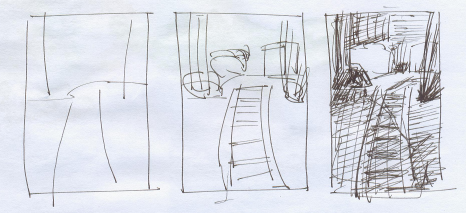
Now draw a few thumbnails each should not take you more than 10-25 seconds.
(2) Thumbnail
  • Draw 3-4 gestural lines exploring the frame.
  • Identify major forms, 3-4 maximum.
  • Identify the tones, using 2 tones and the white of the paper.

Here is an example (Let me add that step (1) is already taken care of well in these examples through the eyes and lens of Murali)


Another example..


These simple preliminary steps aid in a better picture subsequently. Next steps include how we organize the space into foreground, middle ground and background, and how we use techniques such as linear and atmospheric perspective as well as textures to define the three planes, etc.

Equipped with this simple yet effective tools, we can create more effective sketches, in an enjoyable manner.